Flagship · Live in free private beta
Kinclara
A caregiving coordination platform for families managing the care of an ageing or unwell relative. Eighteen months of work: the product, and everything around it that decides whether a product gets used.
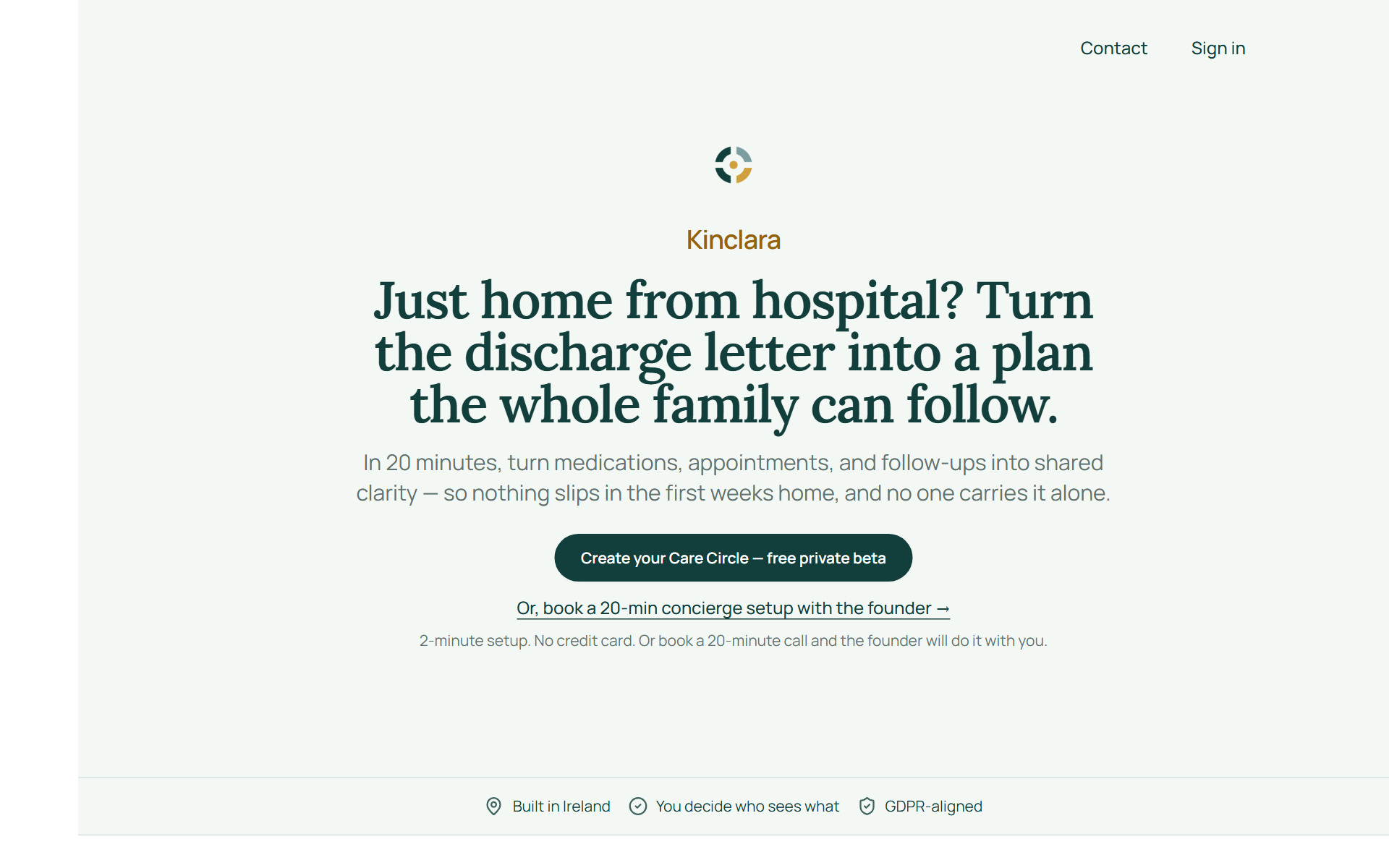
The problem
When a parent comes home from hospital, the coordination lands on the family — usually in a WhatsApp group. Medication changes, follow-up appointments, who is collecting what, who called the GP. Group chats are built for conversation, not for state. The important detail scrolls away, and one person quietly ends up carrying all of it.
The sharpest version of this is the first fortnight after a discharge, when the instructions are densest and the family is least organised.
What I built
Kinclara gives the family one shared, private place for the practical work of care: medications, appointments, tasks, notes and shared visibility. Setup is designed to take about twenty minutes, starting from the discharge letter the family already has in their hand.
Two deliberate constraints shaped the product. It coordinates the family, not the care — no medical decisions, no diagnosis, no monitoring. And the person at the centre decides who sees what, rather than everything being visible to everyone by default.
Alongside the self-serve flow, families can book a twenty-minute concierge setup with me and I do it with them. That has been the fastest way to learn where the product actually breaks.
How it is built
React and TypeScript on the front end, Firebase Authentication and Firestore for identity and data, with services on Vercel and Railway. The whole thing was migrated off a low-code platform onto this independent stack — a full rebuild rather than a port, done to remove a dependency that would have capped what the product could become.
Product analytics run in an EU PostHog project, so behavioural data stays in the region.
The half nobody sees
The app is roughly half the work of the last eighteen months. The other half is what decides whether it gets used at all.
Instrumentation. Event design and analytics from the first release, in an EU PostHog project, so questions about activation and drop-off have answers rather than theories.
Product-led growth and lifecycle. Onboarding designed to reach value in one sitting, then a lifecycle email programme keyed to what a family has actually done — signed up, activated, gone quiet — rather than to how many days have passed.
Outreach tooling. Custom tooling to research, draft and log founder outreach, because the acquisition channel for this product is conversations, not ad spend.
Dashboards. The funnel, the cohorts and the lifecycle stages in one place, so the next decision is informed by the last one.
Where it stands
Kinclara is live and in free private beta. Core features are free to use and will stay that way. The current work is acquisition — specifically, reaching families at the moment the coordination actually breaks, rather than trying to interest them in caregiving software in the abstract.
Let’s talk
Building something real with AI?
Open to the right role, project, or collaboration. If you’re building something real with AI — or need someone who can — get in touch.